
If you want to restore science, you need science journalism
It was in my honours year, between the strained screams of an Underoath song blaring out of a car stereo, that I heard an almighty screech. The back half of my car swerved momentarily before I readjusted and realised what had happened. I'd just turned onto the street where my laboratory stood and BANG — my 1985 Ford Telstar kissed by a larger, far more beautiful automobile: A white Mercedes Benz.
The driver of the other car followed me and we parked in a driveway right next to my lab. He came out hot — raging — screaming expletives about how I'd fucked his car. As a man of science, I took a beat to think about this. Hypothesis: If my car is hit from behind in my own lane, then I am not responsible. Science wins again. The rage was followed by about 10 minutes of simmering, clenched teeth passive-aggressive abuse... which slowly gave way to Human Conversation after we exchanged insurance details.
As it turns out, this was (is!) a Big Scientist Type. And he's actually nice enough as a bloke, too, past all the blame-shifting. I file this information away for almost five years.
Because as I approach the end of my studies, I need a job. And the Man Who Crashed His Merc Into Me is a man that might help me maintain a stable academic career. The laboratory I had been working in had been unsuccessful in accruing grant funding to continue research over a few years, and was almost running on fumes. And as I was approaching the end of my doctoral studies, I had to find somewhere to go.
This is crazy to think about now and, as you know because you're reading this, I left academia entirely and ended up going into the much more lucrative and fulfilling business of 'science journalism' (idiot). But the Merc-driver With a Maybe-job-for-me story came to me recently when I was thinking about the state of science funding in Australia. I was reminded that I once saw a car crash as one of the few ways to progress my scientific career.
Now, another car crash: Science in Australia.
Our PhDs are paid a terrible wage to perform research. In 2026, the minimum scholarship for a PhD was worth $34,315. A dismal, non-livable wage, below the poverty line. The recent Strategic Examination of Research and Development (SERD), or "Ambitious Australia" report, which evaluated Australia's research enterprise, suggested stipends should be raised to $50,000 – but only in national priority fields. [Ambitious Australia also identified the same old sickness in Australian innovation, just a brand new strain since the previous report in 2008].
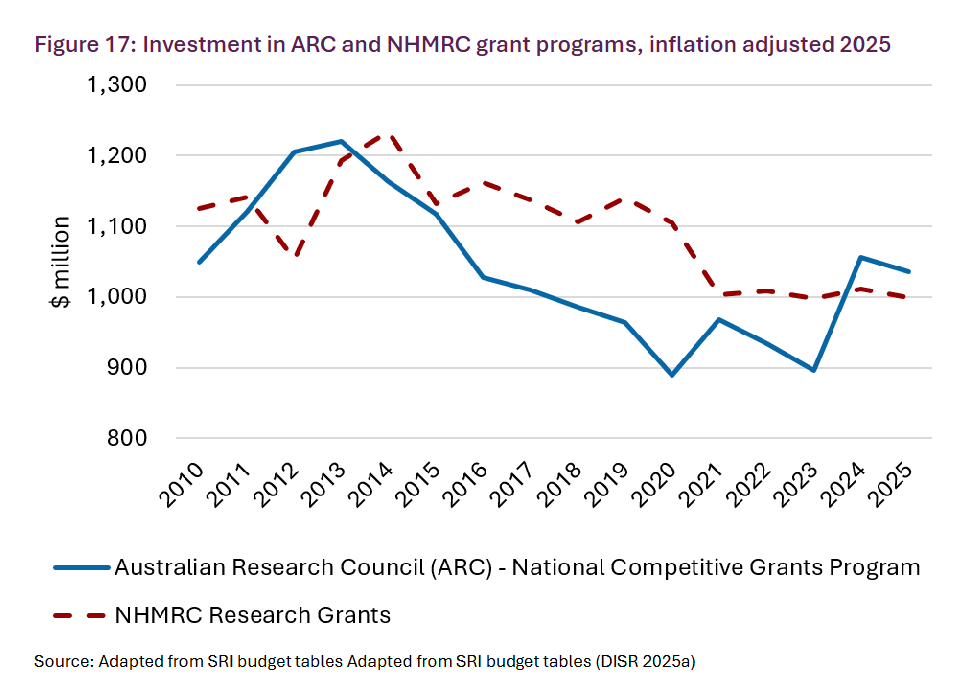
And there's the slog that researchers go through, year after year, applying for grants from the NHMRC and ARC, trying to win funding is becoming cutthroat, and the rejection rates are astonishing. In 2025, the NHMRC Ideas grants, a major scheme for health and medical research projects, funded just 8.1% of applicants – 190 of the 2,347 applicants. Overall funding for competitive grants has dropped 15% (ARC) and 19% (NHMRC), as the Figure 17 graph from the report shows below.
Being an academic and a researcher and a scientist is freakin' hard, man.
There are efforts to arrest the declines. The Ambitious Australia report notes "immediate action is required to reverse the fall in support for foundational research" but so far, minimal action has been taken. At the end of last year Monique Ryan, member for Kooyong, urged the government to release more medical research funding from the $20 billion Medical Research Future Fund (MRFF).
That campaign, kinda?, worked. The Federal Government committed to upping the expenditure with a goal of reaching $1 billion spent by 2030-31. But Ryan showed that MRFF expenditure could be doubled, TODAY, from $650m per year to about $1.4b per year and there would be no impact on the fund's long term finances. In reality, we're missing out on almost $3 billion in funding over the next four years by holding off from an immediate increase.
"It is just unacceptable," says Shane Huntington, CEO of the Australian Society for Medical Research. "And yet most people have cheered that." Huntington also worries about the 2030 promise being kept, given it will arrive after the next Federal election.
Right now, the Australian Academy of Science is leading a valiant effort to call on Australia to "Restore Science". Ostensibly, it's an email campaign to get the government to back in research & development. In Australia, we spend just 1.69% of our GDP on R&D, whereas the OECD average is 2.72%.
"I love that they've called their programme Restore Science," says Huntington. "They're openly stating — this is Australia's Academy of Science — saying the government funding scenarios have damaged science."
As of writing, it's ticked past 11,000 emails sent, though that's likely to increase before you read this. Senator David Pocock has got behind this too. I applaud the Academy's efforts here, it's no small feat to get anyone behind a campaign these days — but I am also a little surprised at that number. Australia is home to around 180,000 researchers, according to the figures released by Universities Australia in 2020. About 45% are based in universities. That number may be higher now, given the six-year-lag in data. Are we not reaching these people?
And what of the public? Do you care about how much scientific research is funded? Do you believe in the value of it?
The Academy's Restore Science campaign suggests you very much do! They wrote that 91% of Australians "actively seek out news of scientific discovery." The number seems to come from an ANU poll conducted by the Centre for Social Research and Methods in 2023. If (super big if because this seems like garbage) that number is true and has held... then that's a huge market of, uh, around 25 million people who would probably want scientific discovery to be funded also, right?
And yet, scientific discovery is largely hidden from view, tacked on to the end of a broadcast, right next to the squirrel that can surf. Every once in a while, science might land a magazine feature. Although, there's not many science magazines left, either...
Where's all the science in our media landscape that these readers desperately want? And how can it help restore science?