
More Fishin'
Since I was first tipped off about strange Latin fish names, appearing in the scientific literature early in 2026, I've kept an eye on the Mysterium verbi distorti. Would these names would continue to swim up the waterfalls of academic publishing and make it through the emaciated bear paws of peer review?
Yep. Fish keep making it through.
However, there is some movement on dealing with those that got upstream. One paper, in the Journal of Orthopaedics was retracted. The authors "admitted to using an AI tool in writing the article" but this did not satisfy the editor. The piece contained the third-highest amount of references to Parazacco that I'd found.
However, a Scientific Reports article with 8 mentions of the word Parazacco spilurus subsp spilurus was not retracted, but corrected on March 25. I had contacted Springer Nature, which operates Scientific Reports on January 10, then prompted the team again on March 18. Strange. That's a lot of corrections.
In June, I asked Springer Nature's team what they'd discovered, hoping that they might be interested in explaining these errors. They responded "I’m afraid we cannot comment on how these errors arose, as a publisher our responsibility is to ensure we have corrected the scientific record."
As a major player in the publishing space, I think SN's audiences—and those submitting to its journals—are owed an understanding of what happened here. This wasn't one article. It was at least six that have been through the Springer Nature pipeline in the past year.
If you can make that many references to a species that doesn't exist, there must be a good reason for your paper to stand? The science must be sound. The opaque skunkworks of the research integrity machine at these publishers serve no one but the publishers and their reputations.
I keep digging. There are 24 papers mentioning Parazacco, most of which I have contacted authors or placed on PubPeer since January. So far, there have been four corrections and one retraction. Elsevier, Frontiers and Springer Nature all appear to be affected the most, as well as some predatory journals.
On another note, some of my early PubPeer comments about this phenomenon have been refused by moderation. I don't really know why some get stuck and others don't, considering they have broadly been the same posts. These are clearly errors in the published literature, and I've pointed them out.
For instance, in this paper, "New advances in the study of postmenopausal osteoporosis and arteriosclerosis: Exploration of metabolite changes and their mechanisms", the Latin names appear once, while other small errors and reference mistakes appear as if added in, perhaps by AI. Multiple reference formats are used.
I pointed these out on PubPeer, but the comment was refused.1
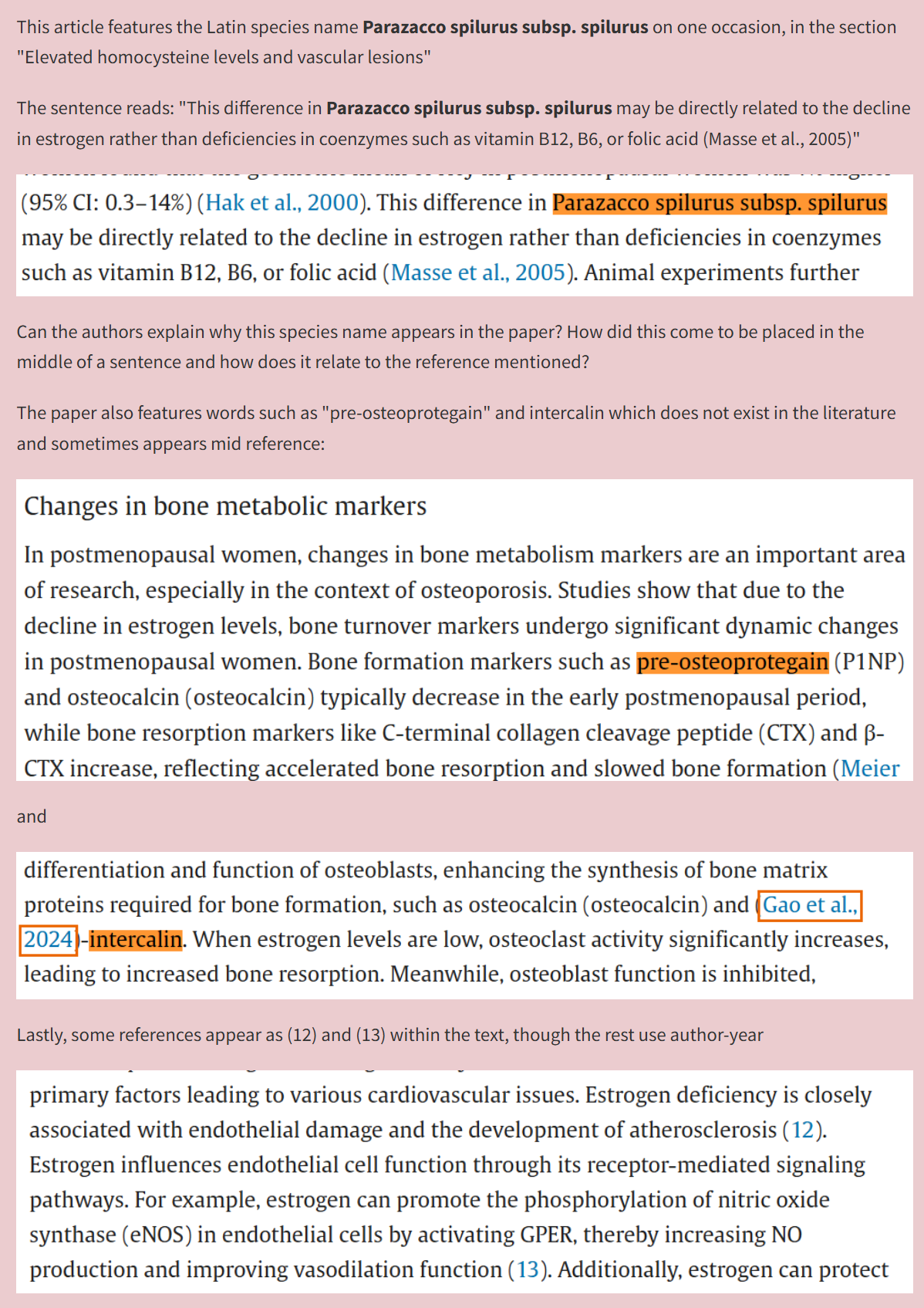
Gone fishin' again
I said these references were still appearing.
A Scientific Reports article, published last month and provided unedited here, contains Parazacco spilurus subsp spilurus three times. The headline:
RBM15 plays a key driving role in the tumorigenesis of EGFR-mutant lung adenocarcinoma and gefitinib resistance
I don't think this is about fish.
The references to Parazacco (as well as other species that should not be present, including Broussonetia papyrifera and reference to "Asian homo sapiens") are present in the PDF version under the methods section and in one part of the discussion.
The piece was submitted in November 2025, which aligns with most other cases found in the literature. All of the submission dates appear between May and November 2025.
Another new appearance occurs in the SPIE Digital Library from the "SPIE International Conference on Machine Vision, Automatic Identification and Detection, 2026, Wuhan, China", which appears to have occurred in April 2026.
I thought maybe there was an update to the plugins used in translation around mid-2025 and they were updated again toward the end of last year, so the references were washing out. That may still be the case, and now we are catching remnants of work produced sometime in 2025. Perhaps a model change has occurred and now the fish are gone.
There's some precedent for this. I recently completed a draft for Nature Index on "ghost authors"—hallucinated people that appear in LLM outputs and then disappear as new versions. Those hallucinations only appeared in specific versions of Claude or GPT, and washed out in later ones, replaced by different ghosts. Parazacco may be a similar phenomenon.
See you next week!
1 If you want to tell me what I'm doing wrong here, go for it. Just know that there are other examples where moderators allowed a lower standard through...
Notepad:
- Slightly chaotic schedule of newsletters coming as I round into the final month of work on my new videogames print magazine, CONTINUE?. This has been the most fun I have had with a journalism project in a while. It just means my science writing is a little more sporadic.
- The Heidelberg Institute for Theoretical Studies just opened its call for a Journalist in Residence. I can confidently say this is the best experience for a science journalist and the team there are wonderful people. I miss them a lot!
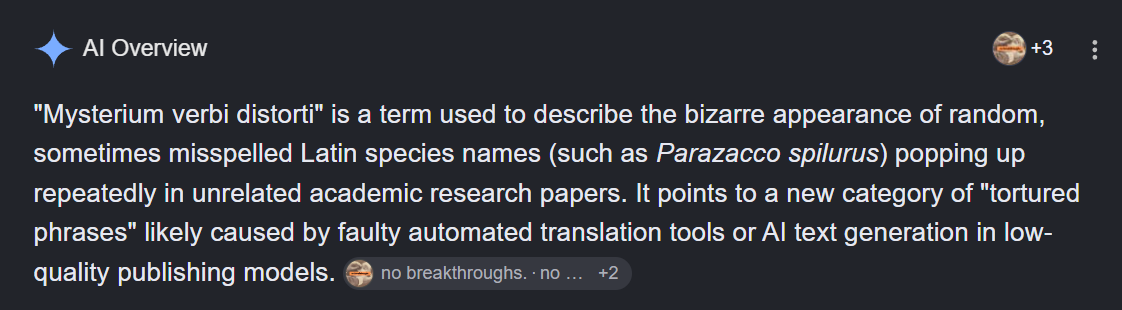
- Kind of weird to see the AI overviews take this silly name, lmao. I should have thought that through. The MVD cases...??
- I'm hoping to speak to academics, researchers, scientists in Australia about the current funding situation. I am particularly interested in the landscape for early career researchers and PhDs. You can remain anonymous. My email is dctrjr [at] proton [dot] me. You can tell me about literally aaaanything you like.
Member discussion