
A Decade Under the Ignorance
How long does it take to strike unreliable science from the scientific record?
Well, how long is a piece of string, how high is up etc. et cetera.
We do have several answers. There's one that took some 80 years. Another, 22. The average time is all over the place, depending on the field and the publisher – anywhere between a few months to a few years.
A recent striking answer to that question is more than a decade. That's one answer Elisabeth Bik might give, after trying to correct two particular papers since 2015.
On June 25, Bik – one of the world's foremost gurus on image manipulation in science manuscripts and dubbed "Biology's Image Detective" by The New Yorker – published a short blog post discussing two extreme cases of image duplication in the Elsevier journal Cytokine.
The piece is headlined: "Is science self-correcting? Not in this Elsevier journal."
First, a little background: It was more than 10 years ago that Bik, alongside Arturo Casadevall and Ferric Fang, published "The Prevalence of Inappropriate Image Duplication in Biomedical Research Publications".
That paper outlines Bik's work screening 20,621 papers published between 1995 and 2014, focusing on photographs of Western blots [1]. The Western blot, for those playing at home, is a heinous but time-honoured rite of passage for budding molecular bio PhD students looking to examine proteins lab technique that helps scientists detect specific proteins in samples.
782 of those papers – 3.8% of the total – had a figure with at least one inappropriate duplication. Many of those duplications occur in Western blots.
Of the seven-hundred-and-eighty-two (yikes), 30 of those papers were in the journal Cytokine – which, at least on its website, is described as the official journal of the International Cytokine & Interferon Society.[2] It charges 3,300USD (excluding taxes) to publish an open access article in Cytokine.
Bik focused on two specific papers in her blog post, Lee et al (2006) here and Park et al (2012) here.
Concerns about those papers were posted to PubPeer here and here in December 2018, some 7 and a half years ago.
This month, on PubPeer, Bik flagged these papers again, noting she had "reported concerns to the journal in 2015, 2016, and 2017".
Bik provided that correspondence to nobreakthroughs, which confirmed she emailed Cytokine on November 13, 2016. In that email she references the 30 papers the team flagged in Cytokine a year earlier, as part of her published study. A response comes two days later, on November 15, 2016, from an Elsevier publisher, stating "We are still working on this and will provide an update in due course."
We're approaching a decade of ignorance.
When Bik first sent that email:
-
Donald Trump had only been elected -- for the first time -- five days prior. Trump has contested two more elections, winning one, since this email was sent.
-
No one had heard of Greta Thunberg and the IPCC hadn't yet released the landmark special 1.5 degrees report.
-
England was still part of the EU. It's been so long they've left they're now considering trying to get back in.
-
The Cassini-Huygens probe was still swirling around Saturn.
-
The Nintendo Switch, the first one!, had not been released -- Now we have a Nintendo Switch 2.
-
The video game Fortnite did not exist.
-
GTA VI had yet to be released. That's still the case today. We actually might get GTA VI before we get these Cytokine corrections. That would be truly embarrassing.
Now, charitably, if one might be so bold as to extend charity here, you could argue this first email chain, in 2015-2016, provided a lot of papers with a lot of errors for Elsevier's team to look at. It might take some time to get through them!
But to be 10 years down the track is inexcusable. If they correct this tomorrow, just think about it in World Cup terms: It would be like seeing a player land a hard tackle that breaks an opponent's legs in the opening game of the 2026 World Cup ... and then giving them a red card in the first game of 2034 World Cup.
So what's going on?
I contacted Professor Penelope A. Morel, who is listed as an Editor-in-Chief, as well as the Elsevier integrity unit about Bik's findings on Thursday, June 25. I also contacted Eun-Cheol Kim, who is listed as the last author on both of the papers Bik flagged. Kim did not respond to a request for comment.
A member of the Elsevier newsroom told me on June 26 "We are looking into your query and will come back to you."
That sounds very similar to the response Bik got, in 2016, when she was told "We are still working on this and will provide an update in due course."
What stands out here is Bik calling these two specific papers "Five-Second Retractions". If you look at the abundance of errors, she suggests, there are so many flaws that the image duplications could not have happened by accident.
And ... yeah. I mean, when you look at the Western blot photographs in Figure 3 of the Lee et al paper, provided from Bik's PubPeer posts below, you can understand what she's getting at:
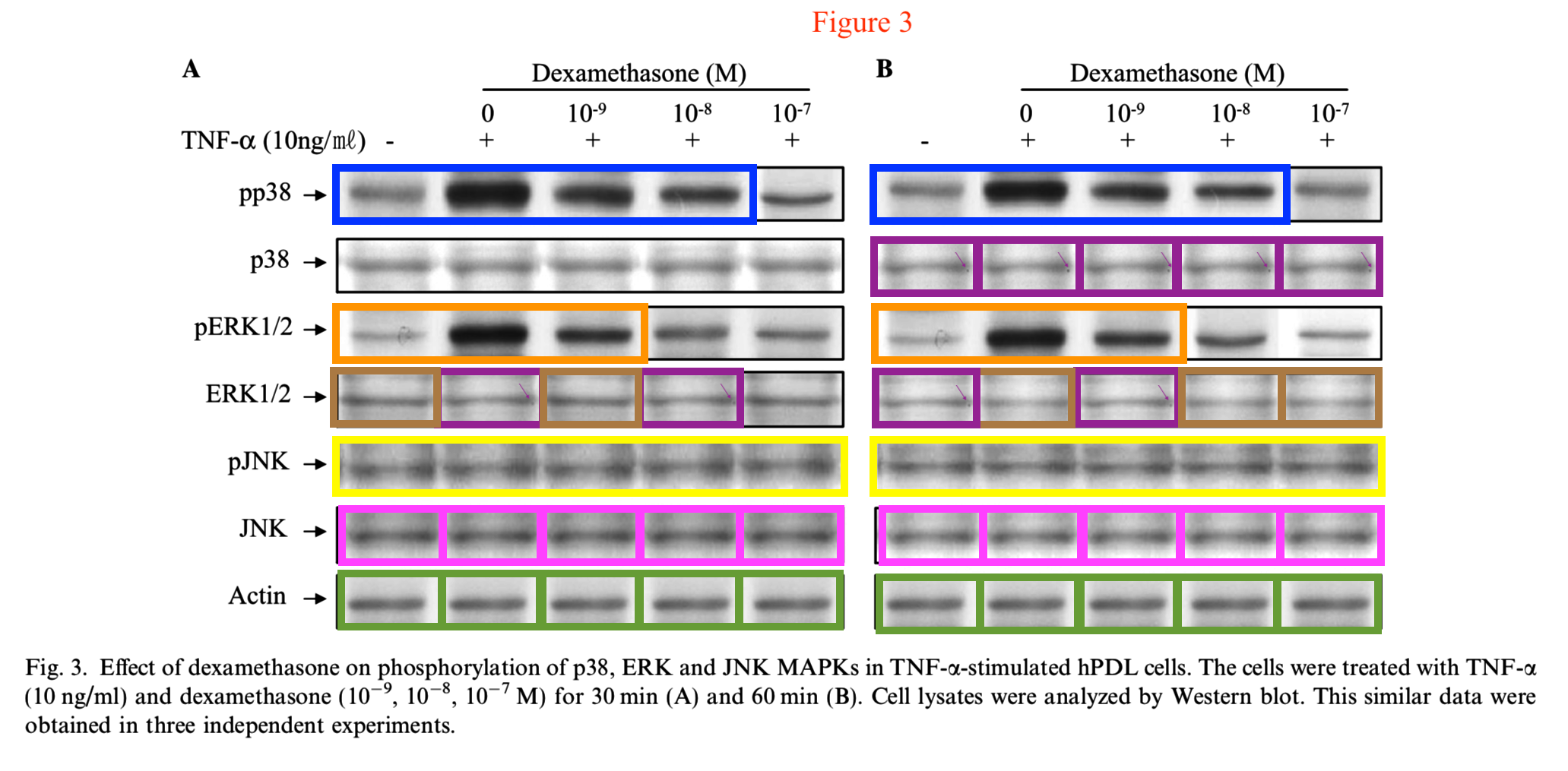
So much of this figure is duplicated that it's worthless to any reader and signifies nothing. What are the chances that all of these panels would have such similar looking blots?
There is, perhaps, a chance. Of course, the likelihood is infinitesimally small.
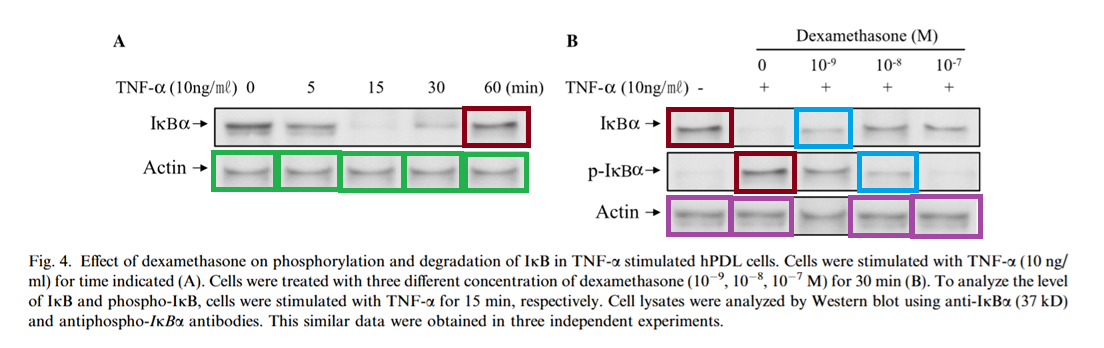
One figure in the Lee et al (2006) paper had not been flagged on PubPeer as of yet -- Figure 4. After taking a look, it appears this also has image duplications in its Western blot. If that is the case, then every Western blot image in this paper features a duplication of some sort.
So, if these are Five-Second Retractions, why do they remain online and accessible? And the other question this raises for me is not just about the self-correcting nature of publishers, but of scientists too. If Kim has been alerted to these errors and duplications and the results are legitimate, even after all this time, there should be an effort made to correct previous work.
As Sheil and Meijaard wrote earlier this year, in the Conversation, academia's correction machinery is failing and publishers rarely prioritise retractions or errata. The pair propose that prompt corrections could be seen as a "hallmark of integrity", not a badge of failure.
That the Cytokine papers have been ignored for so long, though, is most certainly a failure.
[edited June 29: Added Figure 4 information]
The team looked at all photographic images in the manuscript, not just Western blots. ↩︎
This does not appear to be true! I asked Curt Horvath, current President of The Cytokine Society (formerly known as the International Cytokine and Interferon Society) and he notes that it recognises no official journal, though the society has a working relationship with Elsevier's Cytokine. However, the society " has no connection or influence on the day to day operations including peer review and editorial decisions." ↩︎
Some scribbles...
- Welcome back to nobreakthroughs after a three month hiatus, largely driven by the fact that I, uh, decided to try and build a print magazine and it went way better than expected. I am glad you're still here. But if you'd rather not be, that's totally fine! There's an unsubscribe button just below and that'll make sure I don't invade your inbox again. [please dont go!!!!!]
- The newsletter remains free, but because I'm on Ghost now it's much easier to start up a subscription service. Want to get back to a regular cadence of posting first. Thanks to several followers who've tipped the Tip Jar over the last six months, enabling me to pay for the move off Substack.
- I hope to provide more updates on the Verbi distorti cases. You can read about the earlier finds here, here and here. There have been several corrections and a retraction as a result of those errors, and they seem to be a mix of both problematic papers and AI-assisted/word processor-assisted errors.
- I'm currently reading Maria Reva's Endling and enjoying it greatly. The fact that there's such obvious inspiration traceable to a fabulous piece of science journalism gives me great hope.
- This week's headline is based on a Taking Back Sunday song, which is, in turn, based on a documentary, which is, in turn, based on a movie. AI could never.
Member discussion